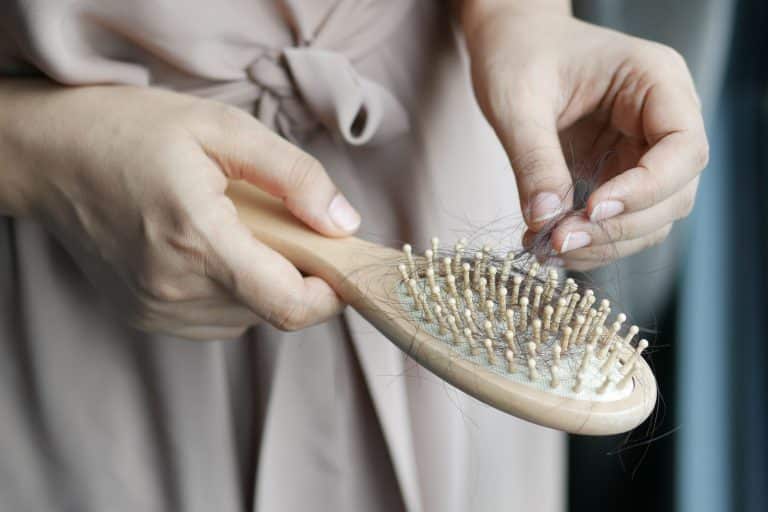
When menopause causes hair thinning, it is one of the most common changes women notice during this stage of life, yet it remains one of the least talked about. Many women feel well prepared for hot flushes and disrupted sleep, but far fewer expect what happens to their hair. Understanding why menopause causes hair thinning, and what can realistically be done about it, makes the change far less frightening and far easier to act on.
How menopause causes hair thinning
During perimenopause and menopause, levels of oestrogen and progesterone fall. Both of these hormones play a supportive role in the hair growth cycle, helping to keep hair in its active growing phase for longer. As they decline, the relative influence of androgens, the group of hormones women produce in small amounts, becomes more pronounced.
In women who are genetically sensitive to androgens, this hormonal shift causes hair follicles to gradually shrink, a process known as miniaturisation. The affected follicles produce progressively finer and shorter hairs, and over time this leads to reduced density, most noticeably across the crown and along the parting. It is a slow process, which is part of why so many women do not connect it to menopause straight away.
What menopausal hair thinning looks like
Menopausal hair thinning usually follows the pattern of female pattern hair loss. Rather than the distinct bald patches some people expect, women tend to see a general reduction in volume, a parting that looks wider in the mirror, and a ponytail that feels noticeably thinner than it once did. Many describe being able to see more of their scalp under bright bathroom lighting, or finding that styles which used to hold simply fall flat.
Because it comes on gradually, it can be easy to dismiss for months or even years. You can read more about the wider picture in our guide to thinning hair in women, which covers the full range of causes.
Why hormones are only part of the story
While the hormonal shift is the main driver, menopause rarely happens in isolation. Several other factors common in midlife can compound hair thinning, and identifying them matters because some are straightforward to address:
- Stress. Significant physical or emotional stress can push large numbers of hairs into the shedding phase, a temporary condition called telogen effluvium.
- Thyroid changes. Both underactive and overactive thyroid conditions become more common with age and can affect the hair growth cycle.
- Nutritional factors. Low iron, vitamin D and other deficiencies are common in women and can contribute to poor hair quality.
- General ageing. Hair naturally becomes finer with age, independent of hormones.
This is why a proper assessment looks at the whole picture rather than assuming every change is purely hormonal. The NHS provides helpful general information on the symptoms of menopause and on hair loss if you would like to read more from an independent source.
Why this is one of the more treatable forms of thinning
The encouraging part is that because the way menopause causes hair thinning is reasonably well understood, it is one of the more treatable forms of hair loss in women. The earlier it is properly assessed, the more options there tend to be, because treatment is generally most useful while follicles are still active rather than long dormant.
Treatment is never one-size-fits-all. Whether a particular approach is appropriate depends on your individual hair loss pattern, your medical history and other personal factors. That is something a doctor determines at consultation, not something that can be decided from symptoms alone. Our page on menopause and hair loss explains the treatment options we offer in more detail, and results vary between individuals.
What to realistically expect from treatment
If treatment is appropriate for you, it is important to have realistic expectations. Hair grows slowly, so any treatment that works on the follicle takes months rather than weeks to show visible change. Many women notice reduced shedding first, with improvements in density following later. Consistency matters more than anything, and ongoing treatment is usually needed to maintain results. Anyone promising a fast or guaranteed transformation is overstating what any hair loss treatment can offer.
Looking after your hair day to day
Alongside any medical treatment, a few gentle habits can help you protect the hair you have. Avoid tight styles that pull on the hairline, be gentle when brushing wet hair, limit high-heat styling, and eat a varied diet with enough protein and iron-rich foods. These steps will not reverse hormonal thinning on their own, but they reduce unnecessary breakage and support the hair you have.
Will HRT help with menopausal hair thinning?
This is one of the most common questions women ask, and the honest answer is that it depends. Hormone replacement therapy is prescribed primarily to manage the broader symptoms of menopause rather than specifically to treat hair. Some women do notice their hair benefits while on HRT, because restoring some hormonal balance can ease the shift that drives thinning, but this is not guaranteed and it is not the reason HRT is prescribed. Whether HRT is right for you is a decision to make with your GP or a menopause specialist, based on your overall health and symptoms. If hair is your main concern, it is worth assessing that specifically rather than assuming HRT alone will resolve it.
How long does menopausal hair thinning last?
Left unassessed, hormonally driven thinning tends to be gradual and progressive rather than something that simply passes. That is precisely why it is worth understanding early. The good news is that this is not the same as saying nothing can be done. With a proper assessment and, where appropriate, treatment, many women are able to stabilise the thinning and, in some cases, improve density over time. As with any treatment, this takes patience and consistency, and results vary between individuals. What matters most is not leaving it for years in the hope it resolves on its own, because the follicles respond best while they are still active.
You are not being vain for caring about this
It is worth saying plainly: hair thinning during menopause can affect how you feel about yourself, and that is a completely valid reason to seek help. Hair is tied up with identity and confidence for many women, and noticing it change at a time when so much else is shifting can be genuinely distressing. You do not need to justify wanting to do something about it, and you are far from alone. A great many women experience this, even if few talk about it openly. Taking it seriously and getting a clear answer is not vanity; it is simply looking after yourself.
When to seek advice
If your hair has started thinning around the same time as other menopausal changes, the two are very likely connected. There is no need to simply accept it as inevitable. A proper assessment can confirm what is happening, rule out any other contributing factors, and set out what, if anything, is worth doing.
If this sounds familiar and you would like a clear answer, you are welcome to book a free consultation with one of our doctors to talk it through. There is no pressure and no obligation to proceed with treatment.